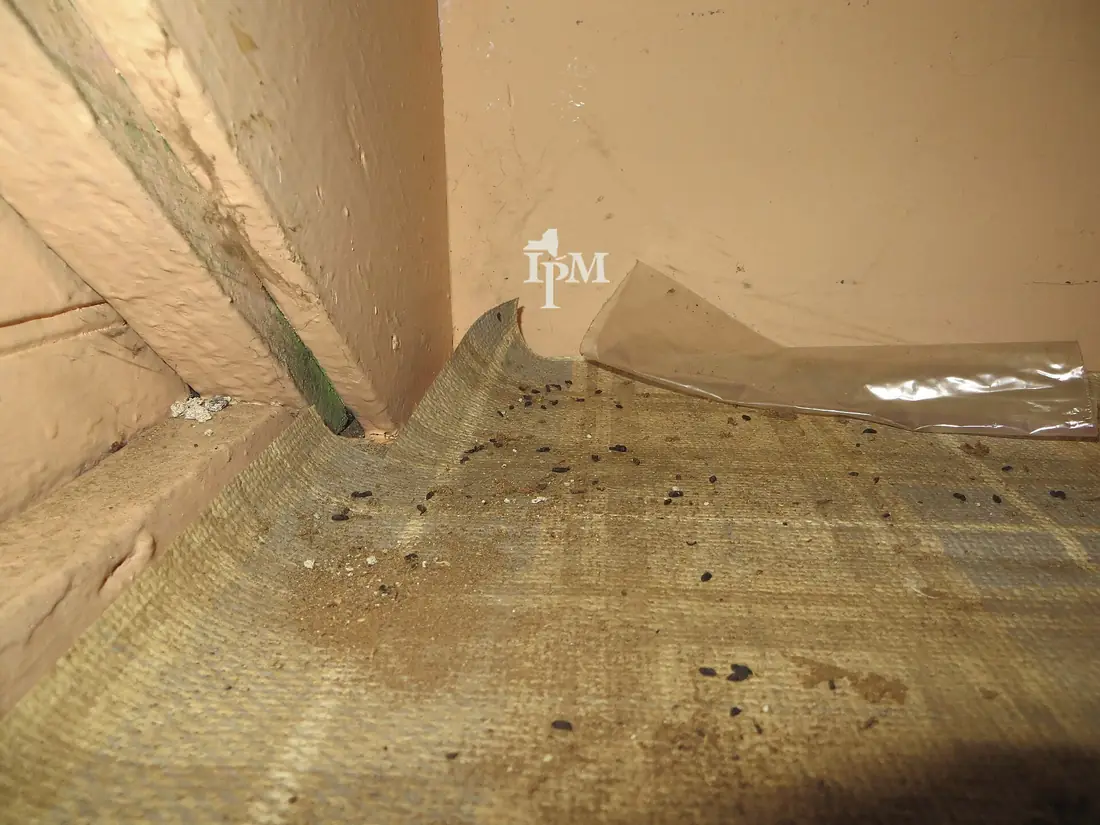
Almost every rodent call to a Worcester home starts the same way: someone opens a cabinet, the drawer under the stove, or a basement shelf, and finds small dark pellets that were not there last month. Droppings are the most honest evidence a mouse leaves. They cannot be hidden, they mark the exact routes the animal travels, and they carry enough information — size, shape, number, freshness — to identify the species and estimate the scale of the problem before a single trap is set.
This guide walks through that identification the way a provider reads it on a visit: what mouse droppings look like, how they differ from rat droppings and from the droppings of cockroaches and bats (the two most common false alarms), what freshness means, where to search in a Worcester home, and how to clean up safely. It ends with the point where identification stops and control begins.
What Mice Droppings Look Like
A house mouse dropping is small: roughly 3 to 6 millimetres long — the size and shape of a grain of rice, or a small sunflower seed. The ends come to a point, which matters for identification. The color runs from dark brown to black when fresh, greying as it ages and dries. Fresh droppings are soft, shiny and almost putty-like if pressed (do not press them with bare hands — see the cleanup section); old ones are dull, dry and crumble.
Quantity tells its own story. A house mouse produces roughly 50 to 75 droppings a day, scattered along its routes rather than piled in one place. A handful of pellets in a single cabinet corner suggests a mouse passing through a feeding spot. Pellets distributed along every baseboard in a kitchen, inside drawers, and across basement shelves suggests established traffic — multiple animals on regular routes. Providers count and map droppings for exactly this reason: the pattern is the population estimate.
Location is the third clue. Mice are wall-followers — they travel edges, not open floor — so droppings collect along baseboards, at the backs of cabinets, behind the stove and refrigerator, along basement sills and joist tops, and in attic insulation near entry holes. Droppings in the middle of open floor are unusual and often mean the pellets dropped from a route above, such as a joist or a pipe run.
Mouse Droppings vs Rat Droppings
This is the comparison that decides the service call, and it rests on size. Rat droppings are three to four times larger: the Norway rat — Worcester's rat — leaves blunt, capsule-shaped droppings about 18 to 20 millimetres long, like an olive pit or a large raisin. Roof rats, less common here, leave slightly smaller, curved droppings with pointed ends. If the pellet in your cabinet is the size of a grain of rice, it is a mouse; if it approaches the size of a small olive, it is a rat, and the job changes completely.
Distribution differs too. Rats tend to use latrine areas — corners of basements, spots along a burrow run — producing grouped deposits. Mice scatter as they travel. A useful field rule: many small droppings in many places means mice; fewer, much larger droppings in defined spots means rats.
There is a middle case worth knowing: a young rat's droppings can approach large mouse size. When the size sits in the ambiguous zone, providers look at the supporting evidence — gnaw marks (mouse gnawing is fine and small; rat gnawing removes real wood), grease marks at holes (rats leave dark rub marks at body height on their runs), and sounds. Heavy thumping and audible gnawing at night belong to rats; light scratching and scurrying belong to mice.
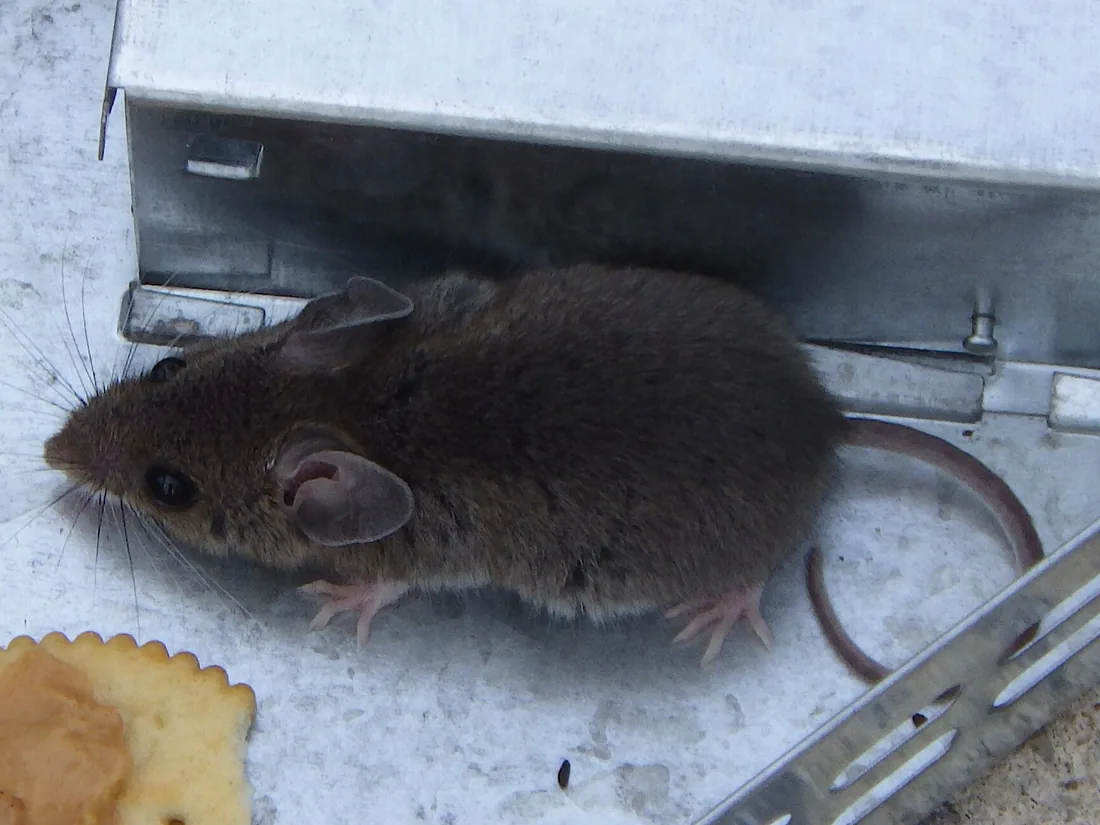
The house mouse: three to four inches long, large ears, and responsible for most droppings found in Worcester homes.
The False Alarms: Cockroach and Bat Droppings
Two other deposits are regularly mistaken for mouse droppings in Worcester homes. German cockroach droppings look like coarse black pepper or coffee grounds — smears and specks clustered in cabinet hinges, drawer corners and behind appliances in kitchens. They are granular, not formed pellets. If what you found crushes to powder and sits in a speckled cluster near the sink or stove, think cockroach, not mouse — and read the cockroach section of the services hub, because the service is entirely different.
Bat droppings — guano — collect below roost points: on attic floors under ridge gaps, on porches and siding below a flashing gap, sometimes in a neat pile under a chimney seam. Guano pellets look mouse-sized at a glance but crumble to a powdery, insect-flecked dust when disturbed (again, disturb them with a tool, not fingers), because bats eat insects and the fragments of wings and shells pass through. Mouse droppings, by contrast, are solid and smooth. Guano under a roofline gap means a wildlife call, not a rodent one.
Droppings are a map. Their size names the animal, their freshness dates the problem, and their location draws the route it travels — read all three before you act on any one.
Fresh or Old? Reading the Timeline
Freshness separates a current problem from history. A fresh dropping is dark, soft and slightly glossy. Within days it dries and hardens; over weeks it fades toward grey and crumbles at a touch. A basement shelf of uniformly grey, dusty pellets may be the record of a mouse that died last winter. One dark, soft pellet among them means the route is still in use.
Providers use a simple test on the first visit: clear a marked area (with gloves and a mask — see below), then check it again after a few days. New pellets in the cleared zone confirm live traffic and show its rate. The same trick works for a homeowner deciding whether a problem is active before calling, and it is far more informative than guessing from a single sighting.
Season colors the timeline in Worcester. A surge of fresh droppings in October and November, appearing in a home that was clean in August, is the classic fall invasion — outdoor mice moving in ahead of the cold. Fresh droppings appearing in deep winter in a sealed-up home, by contrast, point to a colony already resident in the walls, breeding indoors.

Mice live around Worcester homes all year. Fall cold is what moves them — and their droppings — indoors.
Where to Search a Worcester Home
Search the edges, in this order. In the kitchen: under the sink (the cabinet floor and the pipe entries), behind the stove and refrigerator, inside the lowest drawers, and along the back of the counter where it meets the wall. Mice run the pipe chases, and the under-sink cabinet is the station where the chase meets the food.
In the basement: along the top of the foundation wall and the sill, on joist tops beneath kitchen and bathroom plumbing, behind the furnace and water heater, and in stored boxes — especially any containing fabric, paper or pet food. In triple-deckers, add the basement ceiling over the shared utility chase and each unit's under-sink cabinet; the pattern across units shows whether the building shares one population.
In the attic: along the eaves, near any visible daylight at vents, and in the insulation around the chimney and plumbing vent. Droppings concentrated at one eave corner usually sit directly under the entry point the mice are using.
Cleanup — and When Identification Ends
Mouse droppings can carry disease, so cleanup is a procedure, not a sweep. Never dry-sweep or vacuum droppings — that aerosolizes the particles you least want in the air. Ventilate the area, wear gloves and a fitted mask, spray the droppings and nesting material with disinfectant or a bleach solution until soaked, wait several minutes, then wipe everything up with paper towels, bag it, and wash hands and surfaces. Dead mice and nests get the same soaked-and-bagged treatment.
Identification ends where control begins: when droppings are fresh, widespread, or paired with sounds in the walls, the question is no longer what left them but where it gets in. That is the rodent control call — entry-point survey, removal, sealing, and monitoring, in the order described on the rodent control page. Knowing exactly what you found, and where, makes that first call shorter and the visit more useful: tell the intake the size, the rooms, and whether the pellets look fresh.
Get Help With This in Worcester
Identification is the first half. If what you found matches this guide — or you are still unsure — one call to the Worcester intake sorts it: describe the signs and the building, and get matched with an independent local provider who confirms the scope of work with you before anything begins.