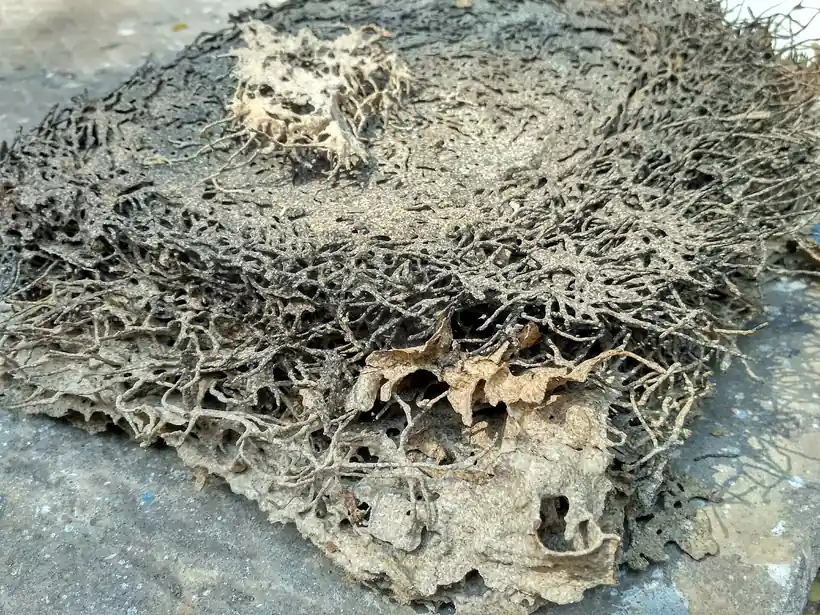
Termites are almost never discovered by seeing a termite. They live in soil, travel inside wood and mud tubes, and avoid light and open air their whole lives — the colony can feed on a house for years while the painted surfaces stay innocent. What homeowners actually find is evidence: a tube on the foundation, a pile of wings, a soft spot in a floor. Learning to read those signs early is the difference between a treatment and a treatment plus a carpenter.
This guide covers each major sign in turn — what it looks like, where it appears in a Worcester home, and what it means — then separates termites from carpenter ants, the other wood-destroyer in Massachusetts houses, because the two are confused constantly and treated entirely differently. It closes with the checks a homeowner can run in one basement visit, and the point at which to hand over to an inspection.
Sign 1: Mud Tubes on the Foundation
The mud tube is the subterranean termite's highway: a tunnel of soil, wood particles and saliva, about the width of a pencil, built up a foundation wall or along a joist so workers can travel between the soil colony and the wood without drying out. Look for them on exterior foundation walls, on the interior basement wall face, climbing piers and posts, and running along the underside of sills. On Worcester's fieldstone foundations they can hide in recessed mortar joints, so run a flashlight at an angle along the stone rather than glancing straight at it.
A tube's presence proves termites have commuted there; it does not by itself prove they still do. Break a small section open (an inch is plenty) with a screwdriver. If the tube contains pale, soft-bodied workers moving inside, the route is active. If it is empty and dry, check again in a week or two: an active colony rebuilds a broken tube quickly, while an abandoned route stays broken. Note what you find and when — an inspector will ask, and 'active in the broken section, rebuilt by Friday' is exactly the evidence that matters.
Sign 2: Swarmers and Piles of Wings
Once a year, mature colonies release swarmers — winged termites whose whole job is to fly a short distance, drop their wings, and found new colonies. In Worcester the season is spring, typically April into May, on warm days following rain. Outdoors, a swarm lasts under an hour and is easy to miss; the evidence it leaves is not: discarded wings, which are translucent, equal in size, and shed in drifts at windowsills, door thresholds, spider webs and light fixtures near the foundation.
Location decides what a swarm means. Swarmers found outdoors, at the base of a fence or a stump, may be a garden colony of no structural concern. Swarmers emerging indoors — pouring from a crack at a basement window, a wall joint or a door frame — mean the colony is feeding in or under the structure itself, because subterranean termites swarm from the top of their feeding system. Indoor swarms and indoor wing piles are the single most urgent termite sign a homeowner can find, and they justify an inspection on their own.
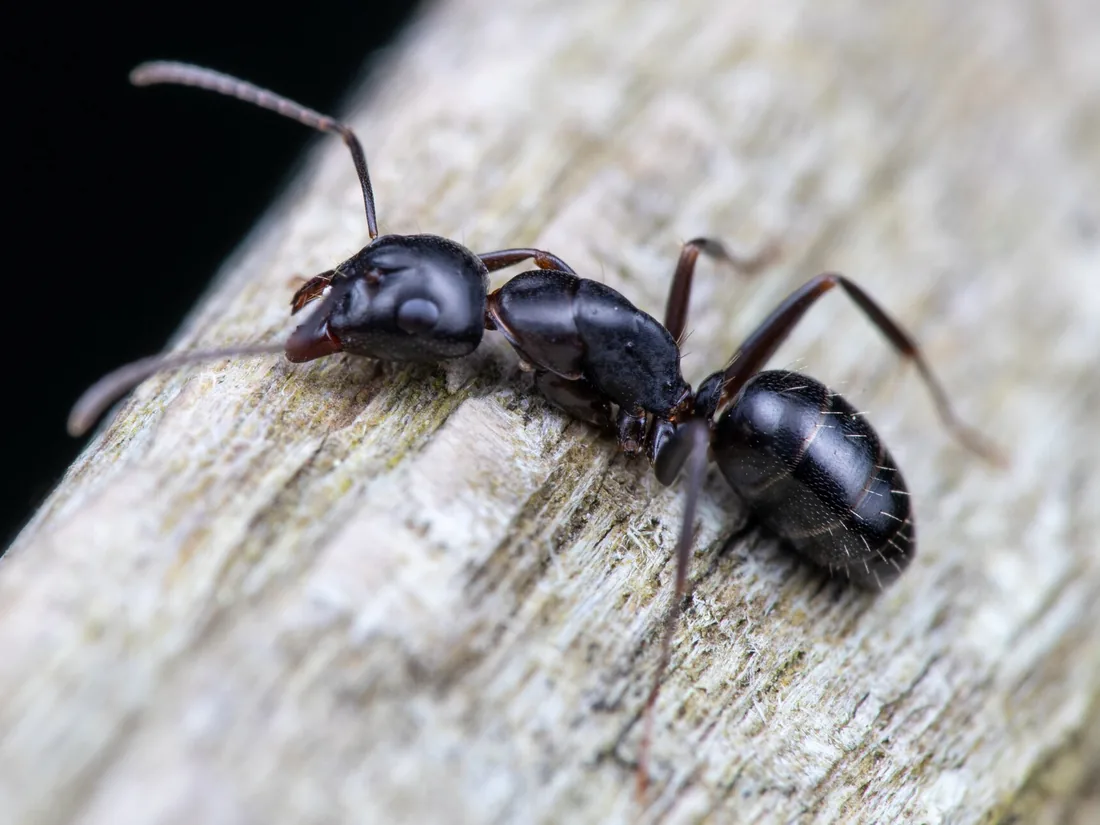
A carpenter ant: pinched waist, elbowed antennae. The differences from a termite are small but decisive.
Sign 3: Wood That Sounds Hollow, Blistering and Soft Floors
Workers eat the soft springwood layers inside a piece of timber and leave the harder grain, so a badly fed sill or joist can keep its shape and paint while becoming a shell. The homeowner tests follow from that anatomy. Tap accessible basement wood — sills, joist ends, support posts, stair stringers — with a screwdriver handle, listening for the shift from a solid knock to a papery, hollow note. Probe the suspicious spots with the screwdriver tip: sound wood resists; fed wood lets the blade sink and flake in layers.
Upstairs, the signs are subtler: paint that blisters or darkens over a hidden gallery, a floor that develops a soft or spongy step, doors that begin to stick as a fed frame settles, and — in advanced cases — the laminated, cardboard-like texture of wood that crumbles along the grain. None of these proves termites alone (water damage imitates several), which is why the basement check matters: the sill below a blistered first-floor wall usually settles the question.
With termites, the debris names the pest: mud means termites, sawdust with insect parts means carpenter ants, and pellets mean you are probably looking at a different problem entirely.
Sign 4: Frass — and Why Its Absence Matters
Homeowners often ask about droppings. Subterranean termites do not leave neat pellet piles around their workings the way drywood termites (a southern species, not a Massachusetts problem) do — their waste goes into the galleries. So a Worcester home with termite damage typically shows no droppings at all, and the presence of granular debris or sawdust under damaged wood points the investigation somewhere else: at carpenter ants, whose frass is the giveaway of their galleries.
This matters because the misidentification is the most common one in the region. Pellets like tiny footballs piled below pinholes in wood belong to drywood termites, which do not live in Massachusetts soil — if you find them here, the piece of furniture or the wood itself arrived from somewhere warmer, and that is a different conversation. Sawdust with insect fragments in it belongs to ants. Mud belongs to termites. The debris names the pest.
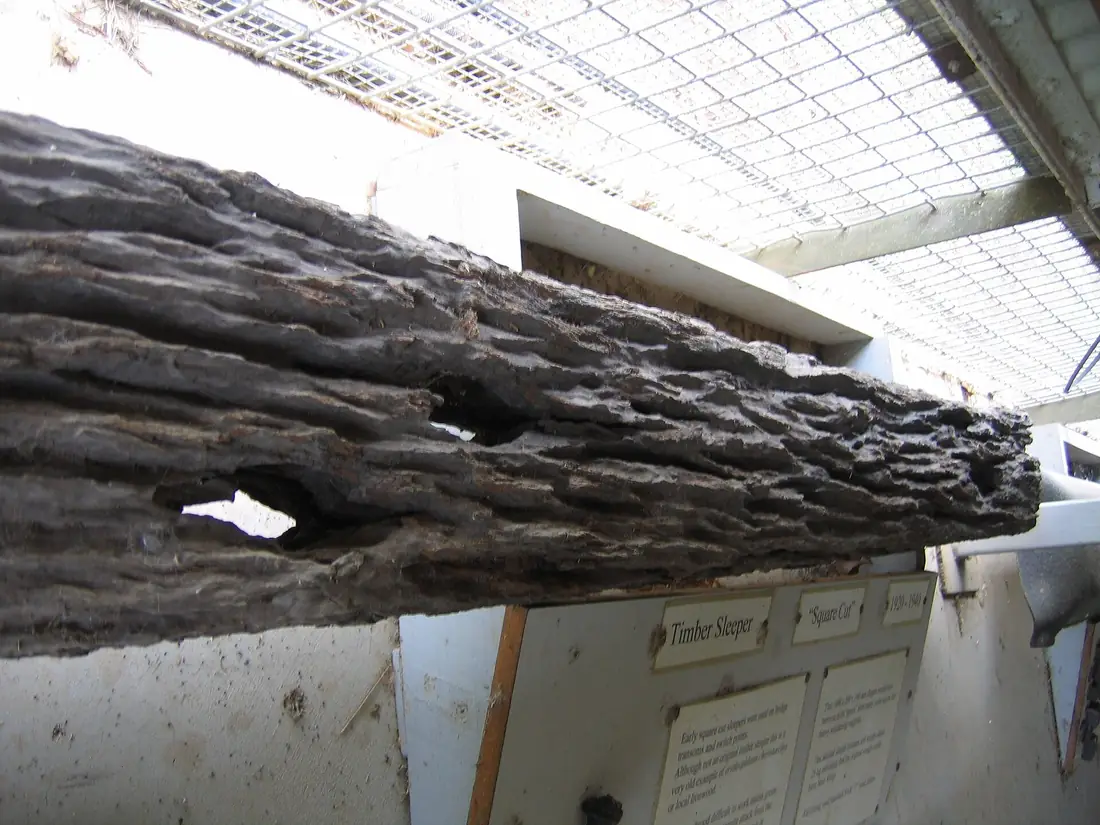
Termite feeding follows the soft grain, leaving the harder layers standing — the honeycomb look of old damage.
Termites vs Carpenter Ants: The Full Comparison
On the insect: a termite worker is pale, soft and grub-like, with a broad waist and straight, beaded antennae. A carpenter ant is dark, hard-shelled, with a pinched narrow waist and elbowed antennae, and its workers vary in size within one colony. Swarmers differ the same way — termite wings in two equal pairs, ant wings with the front pair clearly longer. If the insect in hand is pale and soft, it is never an ant.
On the work: termite feeding follows the soft grain and leaves the harder layers standing in a honeycomb, with mud and soil worked into the galleries. Carpenter ant galleries are smooth, clean and sandpapered-looking, running across the grain as readily as with it, and the debris below — frass — contains sawdust and dead insect parts. Termites eat the wood; ants evict it as rubbish.
On the moisture: both love damp wood, which is why they share houses. But the treatment parting is total — termites are fought at the soil-to-wood route with barriers or baits, ants at the nest itself, which may sit in a tree or stump with satellite galleries indoors. Treating an ant colony as termites, or termites as ants, spends the money and keeps the problem. When the evidence is genuinely mixed or unclear, that uncertainty is exactly what an inspection is for.
The One-Visit Basement Check
A homeowner with a flashlight and a screwdriver can run the meaningful checks in about twenty minutes. Walk the exterior foundation first, looking for tubes, soil piled against wood, and porch posts entering the ground. Then the basement: examine the top of the foundation wall and the sill above it, the ends of the floor joists, the posts, and any wood within a foot of the floor — tapping and probing as described above, and checking behind the furnace and water heater where warmth and moisture meet wood.
Finish at the known risk points: the bulkhead, plumbing penetrations (termites follow the moisture around pipes), the chimney base, and any firewood stored against the house or in the basement. Write down what you find, where, and photograph tubes or damage before disturbing them beyond the small test break. That record turns the inspection visit from a search into a verification — and if the check comes up clean, it is worth repeating every spring, when the swarms and fresh tubes announce themselves.
Get Help With This in Worcester
Identification is the first half. If what you found matches this guide — or you are still unsure — one call to the Worcester intake sorts it: describe the signs and the building, and get matched with an independent local provider who confirms the scope of work with you before anything begins.